
For years, organizations have approached technology decisions the same way: pick a brand, select a product, negotiate a price, and hope it delivers value.
But in today’s environment, that mindset is increasingly disconnected from how businesses actually operate — and it’s costing organizations time, money, and momentum.
It’s Not:“What technology should we buy?”
It’s: “What outcome are we trying to achieve?”
Technology Should Serve the Business — Not the Other Way Around
At its core, IT exists to enable the operations of the business. Production, logistics, customer experience, finance, and frontline teams are the engines that generate revenue and deliver value. Yet too often, those same operational leaders have little influence over the technology decisions that directly affect their performance.
Instead, technology demand is frequently shaped by brand familiarity, legacy standards, budget cycles, or an IT roadmap created in isolation. The result? Operations teams are left with sub-par or misaligned solutions — tools that technically function, but don’t meaningfully support how the business actually runs.
Research into outcome-based procurement consistently shows that defining what success looks like before selecting technology leads to better alignment and innovation. (Queensland Government – Outcome-Based Procurement (PDF))
The IT–Operations Disconnect
One of the most common challenges organizations face is the growing gap between IT and Operations. Operations leaders focus on throughput, uptime, safety, efficiency, and delivery. IT teams focus on systems, vendors, architectures, and security. But neither side is always fluent in the other’s language.
When IT is asked to “pick a solution” without first understanding the operational outcome, decisions default to what’s familiar — not what’s effective. This disconnect becomes especially damaging in manufacturing, logistics, and production-heavy environments, where technology must adapt to the workflow — not force the workflow to adapt to the technology.
Industry research highlights a persistent misalignment between IT delivery and business expectations when outcomes aren’t clearly defined up front. (AWS Executive Insights – Redefining Tech ROI)
When IT Reports to Finance, Outcomes Get Lost
This challenge is often amplified by an organizational structure that has quietly become common — and rarely questioned: IT reporting under the CFO.
Financial discipline is critical, but placing IT primarily under a cost-containment lens reframes technology as an expense to be minimized rather than a capability to be optimized. When IT success is measured by budget adherence rather than business impact, outcome-driven thinking gives way to procurement-driven thinking.
Research from AWS and Enterprise Strategy Group shows that organizations frequently struggle to measure ROI on major technology investments because IT and business leaders define success differently. (ESG & AWS Tech ROI Research (PDF))
A Familiar Example: Implementing AI “Because Everyone Is Doing It”
Nowhere is outcome-blind decision-making more visible today than with Artificial Intelligence. Many organizations feel pressure to “do something with AI” because competitors are talking about it, boards are asking about it, or headlines make it sound urgent.
As a result, AI initiatives often begin with questions like “Which AI platform should we use?” instead of the far more important question: “What specific business problem are we trying to solve with AI?”
A team rolls out an AI tool internally, but nothing changes—because the underlying workflow is still broken, no one owns the metric, and success was never defined. Employees call it “another system,” leadership calls it “innovation,” and the pilot quietly fades.
AI is powerful — but it only creates value when outcomes are defined first: reducing manual admin work, improving forecasting accuracy, increasing equipment uptime, or enhancing customer response times. AI doesn’t create value on its own. Outcomes do.
Research on outcome-based contracting reinforces that initiatives fail when tools are selected before outcomes are defined. (ScienceDirect – Outcome-Based Contracting)
Outcomes Should Create Demand — Not Product Lists
High-performing organizations flip the traditional model: instead of IT defining the tools, Operations defines the outcomes, and IT enables them.
Old question
“Which brand should we standardize on?”
Better question
“What should success look like for production, uptime, scalability, security, or customer experience?”
Outcome-driven frameworks emphasize that value is created when organizations define the job to be done before selecting solutions. (Outcome-Driven Innovation overview)
BOSS as an Outcome Finder, Not a Product Pusher
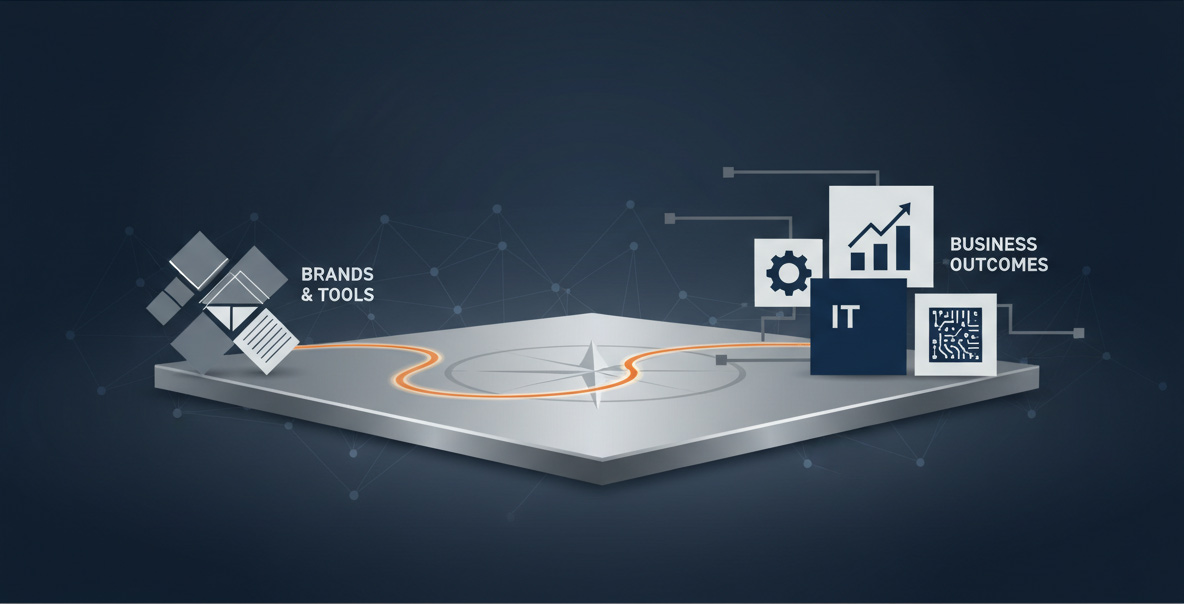
At BOSS, we’ve intentionally positioned ourselves as a Trusted Advisor, not a transactional reseller. With access to 250+ technology partners and our Pathfinder framework, we help organizations translate business outcomes into technical requirements and identify the right solution — not just the most familiar one.
A Modern Example: Meter’s Outcome-First Model
Companies like Meter exemplify this shift. Rather than selling individual networking components, Meter delivers networking as an outcome — predictable cost, simplified operations, reliability, and scalability — all bundled into a single service.
Their partnership with Lumen reinforces this approach by offering enterprises a simplified, outcome-driven WAN-to-LAN experience. (Meter partnership post • Lumen press release)
The Takeaway
- Operations should define demand
- Outcomes should drive decisions
- Technology should follow purpose, not branding
- IT should be measured by impact, not just cost
The future belongs to organizations that stop buying technology for what it is and start investing in technology for what it delivers. At BOSS, our mission is simple: Help you find the outcome — and then the right path to achieve it.
Want a simple outcome-first framework?
If you’re evaluating AI, networking, security, or infrastructure this year, start with the outcome—and build the plan from there. If you want a second opinion, we’re always happy to be a sounding board.
Visit BOSS Business SystemsReferences
- AWS Executive Insights – Redefining Tech ROI: https://aws.amazon.com/executive-insights/…
- ESG & AWS Tech ROI Research (PDF): https://d1.awsstatic.com/…/esg-research-insights-paper-aws-tech-roi-report-pdf.pdf
- Queensland Government – Outcome-Based Procurement (PDF): https://www.hpw.qld.gov.au/…/usingoutcomebasedprocurementapproach.pdf
- ScienceDirect – Outcome-Based Contracting: https://www.sciencedirect.com/science/article/pii/S0268401223000051
- Outcome-Driven Innovation overview: https://en.wikipedia.org/wiki/Outcome-Driven_Innovation
- Meter + Lumen partnership: https://www.meter.com/blog/meter-lumen-partnership • https://ir.lumen.com/news/…/Lumen-and-Meter-Team-Up…

Leave a Reply